
The modern household is no longer just a place of rest; for many of us, it is a high-functioning satellite office and a demanding academic hub. As an entrepreneur, your day is measured in deliverables, KPIs, and growth margins. But when the school bell rings, a second “shift” begins. Supporting a student while scaling a business is perhaps the ultimate test of a leader’s organizational skills.
The challenge isn’t just about finding time—it’s about the cognitive load. How do you switch from a board meeting to helping a teenager understand the nuances of a persuasive essay? The secret lies in applying “CEO logic” to the kitchen table.
The Synergy Between Business Systems and Study Habits
In the corporate world, we thrive on systems. We use CRM software to track clients and Trello boards to manage projects. Yet, at home, we often revert to a chaotic “did you finish your homework?” approach. To bridge this gap, parents should help students view their semester as a product launch.
Start by breaking down the syllabus. Most students feel overwhelmed because they see a giant mountain instead of a series of small hills. By teaching your child to “chunk” their assignments into 45-minute sprints, you are giving them a professional skill that will serve them long after they graduate. This methodical approach reduces the “procrastination paralysis” that hits so many undergraduates.
Understanding the “Product Specs”: The Marking Scheme
Every successful business project begins with a clear understanding of the client’s requirements. In academia, the “client” is the professor, and the “specs” are the rubric. Too often, students work incredibly hard on an essay only to receive a mediocre grade because they missed the technical requirements.
As a business-minded parent, you can help your child by treating the rubric like a contract. One of the most effective ways to do this is by utilizing a professional marking scheme for essay guide from Myassignmenthelp. When you look at these frameworks together, you aren’t just looking at grades; you are looking at the mechanics of logic, evidence, and structure.
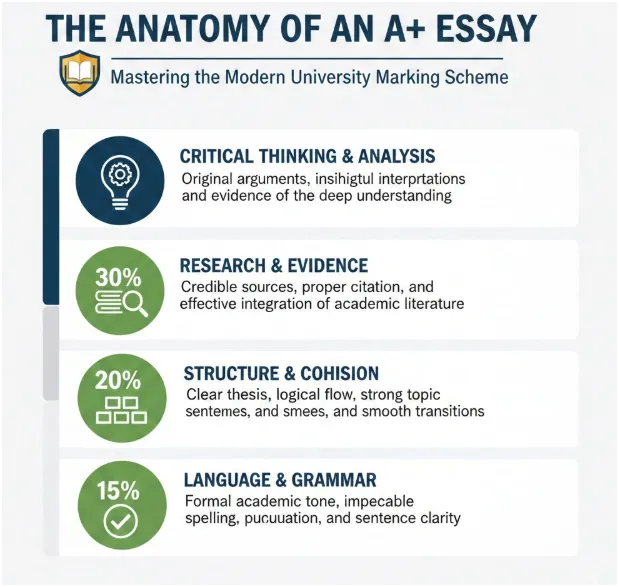
This specific resource helps a student see exactly how a high-distinction paper is built. Does the introduction have a clear thesis? Are the transitions logical? By using these professional benchmarks, the student learns to self-audit their work before it ever hits the teacher’s desk.
The Strategic Art of Academic Delegation
One of the hardest lessons for a new entrepreneur to learn is that doing everything yourself is a recipe for failure. Delegation is not a sign of weakness; it is a sign of high-level management. The same applies to the modern student.
With the rise of “hustle culture,” students are under more pressure than ever. They are expected to maintain a 4.0 GPA, lead extracurricular clubs, and perhaps even run their own side-businesses. During peak periods—such as finals week or the end of a fiscal quarter when your business demands are at their highest—something has to give.
Instead of letting the quality of work suffer, many families are turning to professional essay writing help as a supplementary resource. Think of this as hiring a consultant. When a student sees a professionally written model of their specific topic, it acts as a high-level template. It provides a roadmap for research and a standard for academic tone that they can emulate. This strategic use of external expertise ensures that the student stays on track without hitting a total burnout phase.
Managing the “Home-Office” Environment
The physical environment plays a massive role in academic output. If you are working from home, your child is likely observing your habits. If they see you working in a cluttered, noisy space, they will likely do the same.
Create a “Deep Work” zone that is shared during specific hours. This creates a psychological “co-working” vibe. When you are focused on your spreadsheets and they are focused on their literature review, a silent accountability is formed. This is far more effective than nagging. It turns academic support into a shared professional journey.
Encouraging a Global Mindset in Writing
In today’s interconnected business world, a “Global Tone” is essential. Whether your child is writing for a professor in London, New York, or Sydney, the ability to communicate clearly across cultures is a competitive advantage.
Encourage your student to write for a broad audience. Instead of using localized slang or overly complex jargon, aim for “Plain English” that carries authority. This is the same style we use in international business proposals. It’s about being concise, evidence-based, and persuasive. When a student masters this, their grades naturally rise because their arguments become undeniable.
Leveraging Technology Without Losing the Human Touch
We live in an era of AI and automation, but the “Human Element” is what ranks on Google and what earns top marks in university. While tools can help with grammar or citations, the core of a great essay is the unique perspective of the writer.
As a parent, your role is to be the “Chief Editor.” You don’t need to know the subject matter perfectly. You just need to ask: “Does this make sense? Is the argument compelling?” By acting as a sounding board, you help your child refine their voice. This collaborative process strengthens your relationship and builds the student’s confidence in their own intellectual value.
Mental Health as a Business Asset
In the corporate world, we are finally realizing that employee wellness impacts the bottom line. In education, a student’s mental health is their greatest asset. A burnt-out student cannot learn, and a stressed parent cannot lead.
Recognize the signs of academic fatigue early. If you see your child staring at a blank screen for hours, it’s time to pivot. Sometimes, the best “academic support” you can provide is a 20-minute walk or a change of scenery. Teach them that in both business and school, “grinding” 24/7 is a myth. High performance requires high-quality rest.
Final Thoughts: The Long-Term ROI of Academic Support
The goal of supporting your child isn’t just to get them through the next exam. It’s about building a foundation of executive function, research skills, and the ability to seek help when needed.
By treating their education with the same respect and systematic approach you give your business, you are modeling success. You are showing them that challenges are just problems waiting for a solution—whether that solution is a better study schedule, a clearer understanding of a marking scheme, or the courage to outsource a task to a professional service when the load becomes too heavy.
About The Author
Hi, I’m Jack Williams. With over a decade of experience in the educational sector, I’ve dedicated my career to helping students navigate the often-turbulent waters of higher education. As a senior academic consultant at MyAssignmentHelp, I specialize in breaking down complex rubrics and helping students develop the structural and analytical skills required for modern university success.